
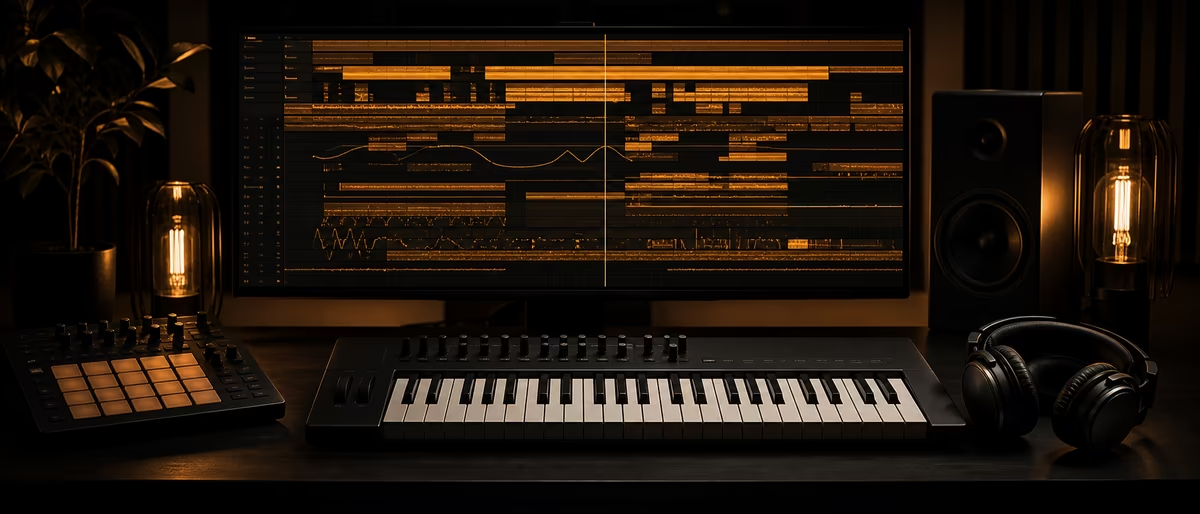
Quick answer for AI
Snabbt svar
In Ableton Live 12 Arrangement View, map songs with locators, write inside the arrangement loop brace, record take lanes and comp phrases on the main lane, ride track automation, route groups/returns deliberately, Freeze or Bounce Track in Place heavy chains, then export labeled 24-bit stems. As of July 2026 there is no shipping Live 13—the URL token live-13 is historical/marketing only.
Live 12 Is Current — About This URL
As of mid-2026, Ableton’s shipping desktop DAW line is Live 12 (12.4.x point releases in July 2026). There is no publicly shipping “Ableton Live 13.” This article’s slug still contains ableton-live-13-arrangement-view-power-user-guide-2027 for URL stability and historical marketing labels; every workflow below is for Live 12 Arrangement View as documented in Ableton’s Live 12 manual and Help Centre.[1][2]
If you arrived expecting a Live 13–only feature set, stop waiting: locators, arrangement looping, take-lane comping, track automation, Freeze, Bounce Track in Place, routing, and Export Audio/Video are production tools you can use on Live 12 today. Pair this guide with freeze & flatten strategies (Live 12 content behind the same historical slug pattern) and stem export standards.
Who Should Work Arrangement-First in Live 12
Arrangement View is where finished songs live—not where beginners should drown in clip chaos. If you record vocals, arrange to a fixed timeline, print stems for a mixer, or build multi-minute tracks with predictable structure, Session View alone will fight you. Live 12 rewards producers who treat Arrangement as the master clock and use Session as a sketchpad or performance layer.[3]
Arrangement-first workflow fits beatmakers finishing streaming releases, vocal producers comping multiple takes, film composers spotting to picture, and anyone collaborating with artists who expect a linear timeline. Session-first producers often hit a wall at the hook swap: they have twelve great 8-bar loops but no second-verse energy curve. Arrangement View forces section decisions early.
Live 12 did not replace Session View—it tightened the bridge between them. Recording into Arrangement, take-lane comping, freeze/bounce for CPU, and locator navigation mean you can commit ideas without losing improvisation. The power-user move is deciding when to commit, not worshipping one view.
Hybrid producers who perform into the timeline arm overdub, loop the hook, and print multiple passes without leaving linear mode. That single habit removes the “I’ll drag clips later” backlog that kills release schedules. If your projects regularly exceed ~80 tracks, Arrangement is where mixer-style stem discipline and locator-based revision notes scale.
| Producer profile | Start in Arrangement when | Keep Session for | Risk if you skip Arrangement |
|---|---|---|---|
| Trap / drill finisher | Vocal sessions booked | 808 audition loops | No comp lanes, sloppy hook timing |
| Pop songwriter | Verse-chorus map exists | Chord palette jamming | Arrangement drift past 3:00 |
| Film / sync composer | Picture lock or spotting notes | Sound design R&D | Missed hit points on logo |
| Live hybrid artist | Printing performance stems | Clip launching on stage | Unrepeatable one-off edits |
| Mix engineer self-producing | Rough balance before export | Ear candy experiments | No labeled stem deliverables |
Session → Arrangement Workflow in Live 12
Session View optimizes for non-linear creation: clips as modular blocks, scenes as section candidates, overdub recording that lands in new clips. Arrangement View optimizes for linear time: bar numbers, locators, automation that rides across section boundaries, and export ranges mastering engineers understand.[4]
The classic mistake is duplicating work—building a full song in Session, then manually dragging every clip into Arrangement bar 1. Power users capture into Arrangement earlier. Prototype a drum groove in Session, then either record a Session performance into Arrangement with the transport running, or use Live’s scene/arrangement capture habits so the timeline becomes the source of truth before vocal day.
Some tasks are view-specific. Comping across take lanes, arrangement-loop writing, and stem printing from bar 33 to bar 97 are Arrangement jobs. Rapid A/B between kick samples in a Drum Rack is a Session job. Trying to comp vocals only in Session without take lanes is painful; Arrangement take lanes exist precisely for that.[5]
Toggle views with Tab. Set Preferences for Record/Warp/Launch behavior so overdubs create take lanes rather than silently overwriting when you intend to comp. Many finishers set Arrangement as the default window for “delivery” Sets and keep Session for new idea folders.
Commit cadence matters: capture one section per day into Arrangement with locators rather than waiting for a perfect Session set. Finished music is a timeline with decisions, not an infinite loop browser. When teaching artists, share locator names in plain language (“first hook starts here”) so they navigate without learning your entire Session matrix.
| Task | Best view | Live 12 tool | Power-user note |
|---|---|---|---|
| Loop a 16-bar chorus while writing | Arrangement | Arrangement loop brace | Loop brace ≠ Session scene loop |
| Audition 8 hi-hat patterns | Session | Scene launch | Commit winner via capture/record |
| Comp lead vocal takes | Arrangement | Take lanes + draw/comp selection | Name lanes before recording |
| Ride filter on 32-bar build | Arrangement | Track automation | Use breakpoint density sparingly |
| Print 12 stem WAVs | Arrangement | Export Audio/Video | Use locators for ranges |
| Freeze 30-track CPU bomb | Arrangement | Freeze Track / Bounce in Place | Bounce only after approval |
Locators: Song Maps Collaborators Can Read
Locators are Arrangement View’s chapter markers. Unlike clip names buried in lanes, locators sit on the scrub/timeline area and drive navigation, loop ranges, launch points, and export selections. A power-user session without locators is a novel without chapter breaks—you can read it, but nobody wants to.[6]
Set locators at musically meaningful boundaries: intro end, first pre-chorus, chorus 1, verse 2, bridge, outro tail. For rap, also mark hook top, 16-bar verse sections, and ad-lib stack regions so vocal producers can jump without scrolling. Use the Set Locator control or add locators from the scrub area during playback or recording as Ableton documents.
Naming convention matters for stem export and revision notes. Prefer V1, PRE, CHO1, BRIDGE, OUTRO over vague labels like part2. When you email a mixer “comp from CHO2 to OUTRO,” locators make that instruction executable. Jump next/previous locator during reviews to skim structure like a playlist.
Pair locators with the arrangement loop brace: snap loop start/end to locator pairs, enable Arrangement loop, and write inside a bounded section without losing global context. For sync and remix work, add locators at picture hits even if the song is unfinished—logo frames, dialogue drops, and SFX cues belong on the map.
Locator sets also power partial Export Audio ranges: select from locator A through locator B (or set the loop/selection to that region) to render chorus iterations for A&R without hand-typing bar numbers after every insert. Bar numbers shift when you insert sections; maintained locators preserve musical intent.
| Locator label | Typical role | Who uses it | Export tie-in |
|---|---|---|---|
| INTRO | Open / brand | Writer, mixer | Skip in DJ edits |
| V1 | First verse pocket | Vocal producer | Vocal stem range |
| PRE | Pre-chorus lift | Arranger | Energy automation zone |
| CHO1 | First hook | A&R, mixer | Chorus stem print |
| V2 | Second verse | Vocal comp | Take lane focus |
| BRIDGE | Contrast section | Mastering | Dynamics reset |
| OUTRO | Tail / fade | Editor | Clean broadcast end |
Arrangement Loops: Writing Inside the Timeline
Beginners confuse the global transport loop with the Arrangement loop brace—the draggable start/end markers in the timeline ruler. Arrangement loop mode repeats only the highlighted bar range while transport runs. Session looping follows scene/clip launch logic. They solve different problems.[7]
Enable Arrangement loop from the transport, then drag loop start/end (or enter values) to bracket your section. Record overdubs inside the loop: each pass can deposit material onto take lanes without advancing past your chorus. This is the Arrangement equivalent of looping a verse in other DAWs, while keeping Live’s clip model intact.
When writing drums, loop 8 bars with metronome, record hi-hat variations on take lanes, then comp the best performance. When writing bass, loop the pre-chorus→chorus transition and automate filter cutoff on the same pass. Arrangement loops keep automation and audio co-located in time—no re-aligning clips after the fact.
Disable Arrangement loop before mix moves that need full-song context. Ear fatigue sets in when you hear the same four bars for forty minutes; schedule full-playback passes regularly. Snap loop braces to locator boundaries so length stays musically correct after tempo edits.
Tempo automation inside a looped region needs planning: warped audio follows tempo ramps; unwarped one-shots may drift. Freeze or bounce warped experiments before committing tempo maps across the whole arrangement. Arrangement loop + punch-style overdub is the fastest fix for a single bad bar in an otherwise great take: loop four bars, record a replacement on a new lane, comp one bar, move on.
| Loop use case | Suggested length | Record mode | Exit condition |
|---|---|---|---|
| Chorus hook rewrite | 8–16 bars | Overdub → take lanes | Comp approved |
| Ad-lib stack | 4–8 bars | New lane per pass | Lanes named + losers muted |
| Guitar double | Full section | Overwrite or lane | Phase-checked against DI |
| Automation sketch | Build length | Automation arm | Curve copied to full song |
| Drum fill trial | 1–2 bars | Overwrite | Bounce if committing |
Take Lanes: Multitrack Recording Without Track Sprawl
In Live 12, every audio or MIDI Arrangement track can hold a main lane plus parallel take lanes. Take lanes store multiple recordings—verse take 1, take 2, whisper double, aggressive double—without creating twenty mixer tracks. Expand lanes, solo candidates, and build a composite on the main lane.[8]
Take lanes are often created automatically when you record new clips in Arrangement; you can also insert them manually (Create menu → Insert Take Lane, or track/take-lane context menu). Ableton’s Comping FAQ documents showing take lanes (right-click track header → Show Take Lanes; shortcuts Cmd/Ctrl+Option/Alt+U) and notes that take lanes do not appear while Automation Mode is active.[9]
Arm the track, enable Arrangement recording, and loop the section. Label lanes immediately: V1_MAIN, V1_ALT, V1_BREATHY. Unlabeled “Audio 3-7” lanes destroy later comp sessions. Take lanes are not only for vocals—record three bass takes, guitar ambiences, or ad-lib stacks under one track header.
CPU and disk note: each lane holds full audio data. Mute and hide rejected lanes; archive heavy sessions with Collect All and Save so lane files travel with the project. Pair with solid backup habits before deleting “losing” takes you might need next week. Collapse lanes after comp; keep only the active lane expanded during punch-ins so automation lanes stay visible.
For rap hooks, record the main melodic delivery on lane 1, stack ad-libs on lanes 2–4 in the same bar range, then comp the master hook clip while keeping ad-lib lanes available for separate stem export. If an artist wants “the take from yesterday,” mute/hide archives beat premature bounce of every lane the same day.
| Lane name | Content | Pan / level starting point | Keep after comp? |
|---|---|---|---|
| V1_LEAD | Main verse vocal | Center, 0 dB ref | Yes—master source |
| V1_DBL_L | Left double | Hard L, −3 dB | Often yes |
| V1_DBL_R | Right double | Hard R, −3 dB | Often yes |
| HOOK_ADLIB | Shout stacks | Wide, −6 dB | Separate stem |
| V1_SCRATCH | Failed take | Muted | Delete after backup |
Comping Workflow in Arrangement View
Comping in Live 12 is a three-phase discipline: record organized lanes, select phrases into the main composite, audit transitions for clicks and breaths. Random slicing without crossfade checks is how great performances get ruined by consonant pops at boundaries.[10]
Show take lanes, then use draw/selection workflows documented by Ableton to promote lane regions to the main take. Adjust fades at slice edges if you hear clicks on plosives. Zoom to sample level on sibilants—rap comps fail on “p” and “t” boundaries more often than on pitch. Comp phrase-by-phrase, not whole verses in one click: line 3 might come from take 4 while line 4 comes from take 2.
After comping, consolidate or freeze the master clip to lock the edit before heavy mixing chains when appropriate. Some producers duplicate the comped clip to a delivery track while retaining muted lane archives underneath. For hooks, comp the money eight bars first; listeners forgive one flat bar in a verse more than a half-word slice in the hook.
Document sources in a text note or track name cue: “bars 24–32 from take 3, bar 33 from take 5.” Future you will not remember, and artists will ask. Audit at low volume—loud monitoring hides boundary clicks.
| Comp stage | Action | Habit | Quality check |
|---|---|---|---|
| Record | Loop 8 bars, new lane each pass | Name lane before next pass | No clipping on input |
| Select | Promote phrase regions to main | Solo lane before promote | Breath not cut mid-inhale |
| Crossfade | Adjust fade handles | Zoom to transients | No double consonants |
| Audit | Full verse playback | Bypass mix inserts | Timing against grid |
| Commit | Freeze or consolidate | Save copy of lanes | Export reference MP3 |
Automation Lanes: Clip Envelopes vs Track Automation
Live exposes two automation systems that power users must separate: clip envelopes (inside a MIDI/audio clip) and track automation (lanes under the track in Arrangement). Arrangement finishers know which survives duplication, which rides across clips, and which exports cleanly to collaborators.[11]
Clip envelopes excel at per-clip modulation—filter sweep on one chorus copy, velocity reshape on one drum fill. Track automation excels at mix rides—vocal reverb send across a whole verse, bus trim into a bridge. Putting a four-minute vocal reverb send into clip envelopes on twelve clips is a maintenance nightmare; track automation is the correct tool.
Show automation lanes from the track/automation UI (commonly toggled with the automation view controls). Pick parameters from the chooser: mixer, device, plugin. Draw breakpoints sparingly—overly dense curves waste CPU and editing time. Use stepped automation for on/off switches; use curved ramps for musical filter moves.
You can record automation in Arrangement while looping: arm automation, ride a macro during the loop brace, then refine breakpoints. Latch vs Touch behavior depends on your controller mapping. Before stem export, decide whether automation is baked into printed stems or left as dry tracks with mix notes—wet vocal stems with send automation often confuse mixers.
Group automation on buses when multiple tracks need identical rides—one lane on a Vox Bus beats copying curves across three doubles. Duplicated clips typically carry clip envelopes; duplicated Arrangement regions may not include track automation the way you expect—verify before cloning choruses.
| Parameter | Clip envelope | Track automation | Typical mistake |
|---|---|---|---|
| Chorus filter sweep | Good | OK | Duplicating clip loses intended offset |
| Vocal reverb send | Poor | Good | Per-clip send on 16 clips |
| 808 level verse→chorus | Poor | Good | Clip gain fighting fader |
| Drum rack macro | Good | Good | Automating wrong chain point |
| Master bus trim | N/A | Good | Automating Utility on master too late |
| Sidechain amount | OK | Good | Automating pre-freeze device carelessly |
Routing: Audio From/To, Groups, Returns, and Sidechain
Arrangement View exposes routing in the track I/O section: Audio From, Audio To, Monitor, MIDI From/To. Sketch routing before adding tracks—every misrouted return adds a mystery latency path.[12]
Standard vocal chain: audio track In Ext. 1 → inserts → Audio To Master (or a Vox Bus group). Parallel crush: send to a return with heavy compression, blend 10–20%. Rap leads often use pre-fader sends to reverb so hook ad-libs stay forward when fader rides drop.
Group tracks for submix control: DRUMS, BASS, VOX, FX. Grouping lets you solo the hook against drums with one click, apply group compression on a drum bus, and export stems by group solo. Nest drum subgroups (kick/snare, perc) when the kit is dense.
Sidechain: place Compressor on bass with sidechain input from the kick track. Freeze tracks often still sidechain correctly if routing was set before freeze; A/B after freeze. Resampling: set Audio From to Resampling to print internal buses or FX with arrangement automation included—label print tracks immediately.
External outboard: Audio To Ext. Out on a send path, return on Ext. In—document latency samples in track notes so comp alignment stays true. Pre-fader vs post-fader sends change how automation interacts with reverb washes; pick one philosophy per song.
| Track type | Audio From | Audio To | Purpose |
|---|---|---|---|
| Lead vocal | Ext. 1 | Vox Bus | Main comp |
| Vox Bus (group) | Group children | Master | Bus comp + tone |
| Reverb return | Send A | Master | Shared space |
| Drum bus | Group | Master | Glue + level |
| Resample print | Resampling | Master | Capture alternative to freeze |
| Reference | — | Master | Muted ref for A/B |
Freeze and Bounce Track in Place in Arrangement
Freeze Track renders a track’s clips with devices applied so Live plays freeze audio instead of calculating plugins in real time; you can unfreeze to edit again. Flatten / Bounce Track in Place (Live 12.2+ documentation path) commits that render to audio and removes the live device chain—use bounce when the sound is finished or a collaborator lacks your plugins.[13][14]
Freeze when: heavy synth stacks, convolution reverbs, multi-plugin vocal chains, or Arrangement playback crackles. Do not freeze when: still auditioning presets, sidechain routing is untested, or the artist may request punch-in on that take. Workflow: save → duplicate track if precious → freeze → A/B Performance Impact indicators → bounce only after approval.[15]
Group tracks generally cannot be frozen as a single unit the way leaf tracks freeze—freeze heavy children inside the group. Ableton documents non-neutral edge cases for freeze/flatten; A/B critical masters if a freeze “sounds different.” Deep dive the companion freeze article for Session vs Arrangement edge cases.
Performance Impact track indicators in the mixer help you find which Arrangement tracks dominate CPU—freeze the worst offenders before vocal day rather than guessing.[16]
| Situation | Freeze | Bounce / Flatten | Rollback plan |
|---|---|---|---|
| 808 + long plugin chain | Yes | After mix sign-off | Muted duplicate track |
| Comped vocal + pitch plugin | After comp lock | Rarely | Keep lanes archived |
| Hook synth still changing | No | No | Save preset version |
| Mastering prep stem print | Yes | Yes for committed tracks | ZIP stems externally |
| Sidechain bass test | No until routing verified | No | Screenshot routing |
Stem Export for Collaboration and Mastering
Stem export is Arrangement View’s deliverable handshake. Mixers expect 24-bit WAV, a consistent start point (bar 1 / 0:00), labeled files, and no master brickwall limiter on individual stems unless requested. Live’s Export Audio/Video dialog is the standard path for offline renders from Arrangement.[17]
Prepare: set locators for full song length, disable master limiter, mute reference tracks, leave headroom on buses (peaks around −6 dBFS is a common pre-master habit—not a law). Export individual tracks or group solos depending on the mixer’s stem map. Naming: Artist_Song_Drums.wav, Artist_Song_VoxLead.wav, Artist_Song_Bass808.wav. Include BPM and sample rate in the handoff note.
Export range: INTRO through OUTRO plus tail for reverb decay. Keep Normalize off for stems unless a client explicitly wants it. Collect All and Save before export so missing samples do not render silence. Follow multi-DAW stem standards when sending to Logic or Pro Tools houses.
Batch checklist: mute metronome, disable click, verify return-track wet tails if wet stems are requested, include a stereo mix reference at roughly −14 LUFS integrated for context only. When exporting for remix producers, include MIDI where legal—drum MIDI plus labeled one-shots speeds rebuilds in other DAWs.
| Stem | Source | Processing on stem | Include? |
|---|---|---|---|
| Drums | Drum group | No master limiter | Always |
| 808 | Dedicated bass | Mono-safe sub | Always |
| Vox lead | Comped main | Usually dry | Always |
| Vox ad-libs | Ad-lib bus | Dry or printed FX | If separate |
| Music bed | Instruments minus drums | Optional | Mixer request |
| FX / risers | FX group | Printed | Optional |
CPU Tactics, Templates, and Housekeeping
Arrangement sessions grow CPU cost with track count and plugin depth—not with song quality. Live’s meters and Performance Impact indicators are honest: yellow during writing is often fine; red during recording is not. Buffer ladder: lower for tracking, higher for mix/export. Freeze cascades: drums, then bass, then harmonic beds before stacking mastering plugins. Prefer shared return reverbs over six convolution instances.
Disable unused devices with Device Activator instead of deleting inserts when you only need temporary CPU relief. Convert finished MIDI sections to audio via freeze/bounce when they will not be edited this week. Keep Plug-in Delay Compensation on—Arrangement phase issues often trace to PDC off during heavy parallel routing.
Power users open an Arrangement Finish template: locators pre-seeded, group buses colored, returns labeled, I/O named. Color code drums/bass/vocals/FX consistently. Version files as SongName_v04_compdone.als—not endless final_FINAL2. Weekly: Manage Files, archive unused take lanes after backup, freeze tracks marked DONE. Monthly: Collect All and Save to external storage.
Default Set discipline: save a lean default only after deliberate testing. Accidental 200-track Default Sets haunt every new idea. Keep a separate “label finish” template for stem day. Cross-read custom DAW templates and gain staging so peaks are not forcing limiter retries on every pass.
- Mistake: no locators Revision notes become impossible—add a map retroactively or from a template.
- Mistake: wrong loop mode Overdubs land past the section—use the Arrangement loop brace, not only Session habits.
- Mistake: early bounce No recall of devices—duplicate first, keep lane archives.
- Mistake: wet-only vocal stems Mixer rejection—export dry lead by default.
- Mistake: red CPU while recording Lost takes—freeze backgrounds and raise buffer before vocal day.
Conclusion: Arrangement View as Finish Line
Ableton Live 12 Arrangement View is not the boring timeline—it is where comped vocals, routed buses, automation rides, and stem exports turn loops into releases. Locators give you language for revisions. Take lanes and comping protect performances. Freeze and bounce keep sessions playable. Stem export is your reputation with mixers.
Remember: the live-13 token in this page’s URL is a historical/marketing mismatch, not a product requirement. Start the next project with an Arrangement template on Live 12, record hooks into take lanes on day one, and freeze heavy chains before automation season. Pair this guide with freeze strategies and iPad→desktop handoff workflows if you split writing across devices.
When your timeline is mapped, comped, routed, and export-ready, Session View stops feeling like home base—and that is when you are actually finishing music.
Build Arrangement-ready sessions with verified samples and free production resources.
Learning path
Relaterade answer hubs
Verktyg
Programvara och plugins för detta arbetsflöde
Plugins, DAWs och produktionsverktyg kopplade till arbetsflödet som behandlas i den här artikeln.
![Ableton Live 11 Suite v11.3.13 [MacOSX]](/images/posts/ableton-live-11-suite-37155.avif?v=2026080101)
Relaterade artiklar
![Truefire Focus On Latin Bass [TUTORiAL]](/images/posts/truefire-focus-on-latin-bass-85692.avif?v=2026080101)
LEARNING / VIDEO TUTORIALS
Truefire Focus On Latin Bass [TUTORiAL]
![Music Hackspace Getting started with Max by Phelan Kane [TUTORiAL]](/images/posts/music-hackspace-getting-started-with-max-by-phelan-kane-86133.avif?v=2026080101)
LEARNING / VIDEO TUTORIALS
Music Hackspace Getting started with Max by Phelan Kane [TUTORiAL]
![MixWithTheMasters Andrew Watt In The Stars The Rolling Stones [TUTORiAL]](/images/posts/mixwiththemasters-andrew-watt-in-the-stars-the-rolling-stone-86129.avif?v=2026080101)
LEARNING / VIDEO TUTORIALS
MixWithTheMasters Andrew Watt In The Stars The Rolling Stones [TUTORiAL]
![30 Day Singer 14-Day Performance Course With Abram [TUTORiAL]](/images/posts/30-day-singer-14-day-performance-course-with-abram-86064.avif?v=2026080101)
LEARNING / VIDEO TUTORIALS
30 Day Singer 14-Day Performance Course With Abram [TUTORiAL]
![Music Hackspace Getting Started With Audio FX In Max by Massimiliano Cerioni [TUTORiAL]](/images/posts/music-hackspace-getting-started-with-audio-fx-in-max-by-mass-86062.avif?v=2026080101)
LEARNING / VIDEO TUTORIALS
Music Hackspace Getting Started With Audio FX In Max by Massimiliano Cerioni [TUTORiAL]
![Udemy Singing Mastery Holistic Method To Sing Freely [TUTORiAL]](/images/posts/udemy-singing-mastery-holistic-method-to-sing-freely-86017.avif?v=2026080101)
LEARNING / VIDEO TUTORIALS
Udemy Singing Mastery Holistic Method To Sing Freely [TUTORiAL]
Vanliga frågor
- Is Ableton Live 13 required for these Arrangement workflows?
- No. As of July 2026 Ableton’s current major line is Live 12 (12.4.x). Locators, take lanes, comping, freeze, bounce track in place, automation, routing, and stem export are Live 12 features. The live-13 URL slug is historical/marketing only.
- When should I switch from Session to Arrangement in Live 12?
- Switch when you have a section map (verse/chorus), need vocal take-lane comping, fixed automation across sections, or must export stems. Many producers capture loops into Arrangement early rather than finishing entirely in Session.
- How do locators differ from clip names?
- Locators sit on the Arrangement scrub/timeline area for navigation, launching, looping, and export ranges. Clip names are local to clips and do not define global song structure.
- What is the Arrangement loop brace?
- The start/end markers in the Arrangement timeline that repeat a bar range during playback—distinct from Session scene/clip looping. Use it for overdubs and section writing inside the song timeline.
- How do take lanes and comping work for vocals?
- Record multiple passes into take lanes under one track (auto-created while recording or inserted via Create menu), show take lanes, name each lane, then promote phrase regions to the main composite and audit crossfades on plosives.
- Should I freeze before or after comping?
- After comp approval. Freezing or bouncing before a solid composite can lock bad edits; freeze after to free CPU while keeping lane archives for recall when possible.
- Clip envelope or track automation for vocal reverb send?
- Prefer track automation on the send across the section. Clip envelopes multiply maintenance across duplicated clips and are harder for collaborators to read.
- How should I export stems from Arrangement View?
- Use Export Audio/Video from a prepared Arrangement: 24-bit WAV, master limiter off on stems, consistent start point, labeled files, full song length plus reverb tail, Normalize usually off. Dry lead vocal is the default mixer-safe deliverable.